How One Agency Turned a Week of Amazon Prime Day Performance Reporting Into a Few Minutes
Key Takeaways
- A growing Amazon agency was burning days after Prime Day, pulling multiple reports — sales, PPC, returns, inventory, and reimbursement for every client.
- They connected KwickMetrics MCP to Claude and asked it to review Amazon Prime Day performance across all data sources in one conversation.
- Claude returned a plain-English breakdown of what worked, what didn’t, and a priority-ranked action list for each client — the same day, not a week later.
The Challenge
Amazon Prime Day revenue looks impressive on the surface — but without margin context, it’s just a big number. Revenue is the number everyone screenshots, and it’s also the number that hides the most. A record sales day driven by high ACOS, deep Lightning Deal discounts, and higher fulfillment fees can still lose money once the final settlement posts.
Real Amazon Prime Day performance review starts with profit per unit, not units sold. Sales volume and profitability are not the same conversation — sellers and agencies who look at a revenue dashboard and immediately reorder often tie up cash (or client budget) in the wrong SKUs.
The sharper question: after fees, ad spend, COGS, and returns, which product is actually profitable? That’s the figure that should drive your next purchase order — across one account or an entire client portfolio.
What the agency needed wasn’t more reports — it was one conversation, all in one place, connecting sales, ads, returns, inventory, and reimbursements.
The Solution
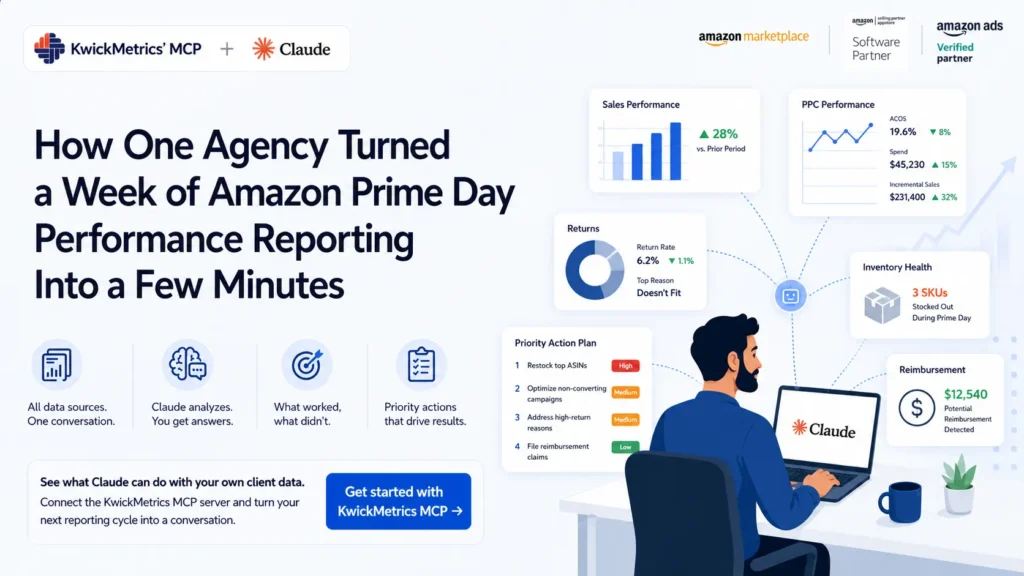
The agency connected the KwickMetrics MCP server to Claude, so account managers could ask, in plain language, for a full Amazon Prime Day sales performance review per client — pulling from sales, PPC, returns, inventory, and reimbursement data in one conversation.
For each client, Claude pulled:
- Sales performance for the Prime Day window versus the prior period, to establish what actually moved
- PPC performance — spend, ACOS, and which campaigns drove incremental sales on amazon prime day advertising versus which just burned budget, cross-checked against saved brand-term keywords to catch defensive spend that wasn’t converting
- Returns by SKU and reason code, to flag categories where post-Prime-Day returns were eating into the sales gain
- Inventory health, to check whether any high-demand SKU ran low or stocked out mid-event and capped what the ad spend could have delivered
- Reimbursement eligibility, to catch FBA discrepancies (lost or damaged inventory, overcharges) sitting unclaimed from the surge in order volume
Instead of handing back mulitple exports, Claude synthesized all of it into one narrative: which metrics performed well, which underperformed, and why — tying the PPC numbers to the inventory numbers to the returns numbers so the account manager could see cause and effect, not just five disconnected charts.
Then it went a step further and ranked the findings by priority — surfacing the highest-impact fix first (say, a stockout on the client’s top ASIN mid-event) ahead of lower-stakes items (a slightly elevated return rate on a secondary SKU), so the account manager knew exactly where to start the client conversation.
See what Claude can do with your own client data.
Connect the KwickMetrics MCP server and turn your next reporting cycle into a conversation.
The Results
What used to take the team the better part of a week now takes an minutes per client — and the output is a prioritized plan, not just a data dump.
“Now Claude pulls the sales, ads, and returns data itself, so there’s no more two or three days lost just assembling it,” the operations manager said. “The client’s still with us when we report back and this time, we actually get to the part that matters what to fix first, ranked by what’s costing us the most.
- Reporting time cut from multiple days to minutes per client, freeing account managers to actually work the action items instead of building the report
- Every client review now includes a priority-ranked action plan, not just raw metrics, which has made post-Prime-Day client calls noticeably more confident and specific
- Reimbursement and inventory issues surface automatically instead of getting missed in the scramble, catching money and stockouts that used to slip through in busy weeks
Get Your Questions Answered (FAQ)
Claude reads directly from the account's connected marketplace data through KwickMetrics MCP, so an amazon prime day performance review reflects the account's current state at the time you ask — not a static export pulled hours or days earlier.
Each client account connects independently, and an account manager can ask for a single client's review or request the same amazon seller analytics across every connected account in one session — without rebuilding the request per client.
No. Each client account is connected and accessed separately, so reviewing one client's Prime Day results doesn't expose or mix in another client's data.
Live signals like inventory stockouts or zero-conversion spend on amazon prime day advertising are reliable to act on immediately. Profit-related conclusions from the full amazon prime day sales performance picture are more accurate once returns and reimbursement data settle in, since early-stage numbers can shift slightly as those come in.
Since Claude — one of the more practical ai tools for amazon sellers and agencies — queries the connected account directly through KwickMetrics MCP each time it's asked, there's no separate refresh step; asking again simply returns the account's current numbers.


Jyothishwari Mohanan is a Senior Content Strategist at KwickMetrics, where she crafts content that helps Amazon and Walmart sellers & agencies navigate the complexities of eCommerce with confidence. With 8+ years of experience across Retail and SaaS brands, she specializes in translating product capabilities into clear, compelling narratives that resonate with real sellers. She works closely with eCommerce teams, digs into seller challenges firsthand, and shapes content that drives both understanding and action.