Amazon Reporting Tool Guide for Agencies in 2026
Table of Contents
- Why Generic Amazon Seller Tools Don't Work for Agencies
- The 4-Layer Amazon Reporting Stack for Agencies
- 8 Must-Have Features for Amazon Agency Reporting Tools
- How to Choose the Right Amazon Reporting Tool for Your Agency
- Why KwickMetrics Is the Amazon Reporting Tool Built for Agencies
- Amazon Reporting Tool Decision Matrix
- Agency Action Plan
- Get Your Questions Answered (FAQ)
TL;DR
Agencies waste 175+ hours/week on manual Amazon reporting while generic tools miss 10-15% of costs and lack cross-marketplace support. KwickMetrics delivers 60% time savings through automated white-label reporting, true SKU profitability, and native Amazon + Walmart consolidation—all at flat-rate agency pricing with unlimited accounts.
Managing Amazon and Walmart accounts for dozens of clients shouldn’t mean drowning in spreadsheets and spending 175+ hours per week on manual reporting. Yet that’s exactly where most ecommerce agencies find themselves trapped in an endless cycle of CSV downloads, pivot tables, and PowerPoint decks that consume 25% of their operational capacity.
The problem isn’t lack of data. Amazon marketplace analytics provides plenty of reports. The challenge is that sales data lives in Business Reports, ad performance hides in the Ads console, fees scatter across Payment reports, and inventory sits in FBA dashboards. None of these systems talk to each other, and none were built for agencies managing 20, 50, or 100+ client accounts simultaneously.
By 2026, the gap between agencies using purpose-built reporting tools or Amazon analytics platform and those stuck with manual processes has become a competitive moat. Agencies with the right tools retain more clients, scale faster, and spend their time on strategy instead of data entry. Those without? They lose clients when a competitor delivers a better audit six months into the engagement.
This comprehensive guide walks you through everything you need to evaluate Amazon reporting tools as an agency. You’ll learn about the four-layer reporting stack framework, understand why generic seller tools fail at agency scale, compare the leading platforms across eight must-have features, and get a clear decision matrix based on your agency size and client mix.
By the end, you’ll know exactly which Amazon reporting tool fits your agency and whether KwickMetrics’ purpose-built platform for Amazon and Walmart agencies is the right investment.
Why Generic Amazon Seller Tools Don't Work for Agencies
Most Amazon analytics tools were built for solo sellers, not agencies juggling 50 clients across Amazon and Walmart. These tools fail agencies in four critical ways.

Single-Account Architecture
Generic seller tools assume one user managing one Amazon account. Their interfaces, workflows, and pricing models weren’t designed for agencies that need to:
- View portfolio-level performance across 30+ clients on one screen
- Drill down from portfolio, client, marketplace, category, ASIN
- Grant role-based permissions so account managers only see their assigned clients
- Track team activity and changes across all client accounts
When you’re logging in and out of 20 different tool accounts daily, switching between clients, and manually tracking which changes were made to which account, you’ve lost the efficiency battle before you start.
No White-Label Client Reporting
Generic tools provide reports branded with their own logos, colors, and “Powered by [Tool Name]” footers. This creates three problems for agencies:
Credibility erosion – When clients receive reports with a third-party tool’s branding, they see you as a middleman rather than a strategic partner. The tool appears to be doing the work, not your expertise.
Competitive vulnerability – Smart clients will Google the tool name, discover they can buy it directly for $50-150/month, and question why they’re paying your agency fee. You’ve effectively created direct competition.
Limited customization – Most seller tools offer rigid report formats with minimal customization. You can’t add your agency logo, adjust color schemes, include custom KPIs that matter to specific clients, or remove competitor branding without expensive enterprise upgrades.
Modern agencies need full white-label capabilities: custom domains (reports.youragency.com), complete branding control, and zero visibility of the underlying tool to clients.
Missing Cross-Marketplace Support
Amazon-only tools force agencies managing Walmart clients into maintaining two completely separate systems:
- One tool/process for Amazon data
- A different tool/process for Walmart data
- Manual spreadsheet reconciliation to match Amazon ASINs with Walmart SKUs
- Separate profitability calculations for each marketplace
- No unified view of which products perform better where
The consequences compound quickly. When a client asks “What’s our total ad spend across Amazon and Walmart?”, you can’t answer without manually adding numbers from two platforms. When they want to know “Which marketplace is more profitable for our kitchen products?”, the analysis requires hours of manual work.
Even worse, double counting has become common. Ad spend gets recorded in both systems, ROAS calculations break, and you end up with inaccurate metrics that erode trust when clients notice discrepancies.
Only a handful of platforms offer native, unified Amazon + Walmart reporting under one login with automated SKU matching.
Surface-Level Metrics (No True Profitability)
The most damaging limitation of generic tools is their focus on top-line metrics rather than true profitability. They show:
- Gross sales revenue
- Basic ROAS (revenue divided by ad spend)
- “Profit” that only subtracts standard FBA fees
What they typically miss:
- All FBA fee types (aged inventory surcharges, low inventory fees, inbound placement fees, removal fees)
- Storage fees (monthly and long-term)
- Return processing costs
- COGS (cost of goods sold)
- Reimbursements owed by Amazon for lost/damaged inventory
For agencies, this inaccuracy is catastrophic. When you tell a client their product is profitable at 18% margin based on tool data, but their accountant analysis shows 8% margin after all costs, you’ve lost trust permanently.
Agencies need tools that calculate complete SKU-level profitability: Revenue – COGS – ALL Amazon/Walmart fees – Ad spend – Returns – Non-reimbursed losses = True contribution profit.
The 4-Layer Amazon Reporting Stack for Agencies
The modern agency reporting stack consists of four integrated layers. Tools that cover all four layers eliminate the need to stitch together 3-5 separate platforms, reducing complexity and cost.
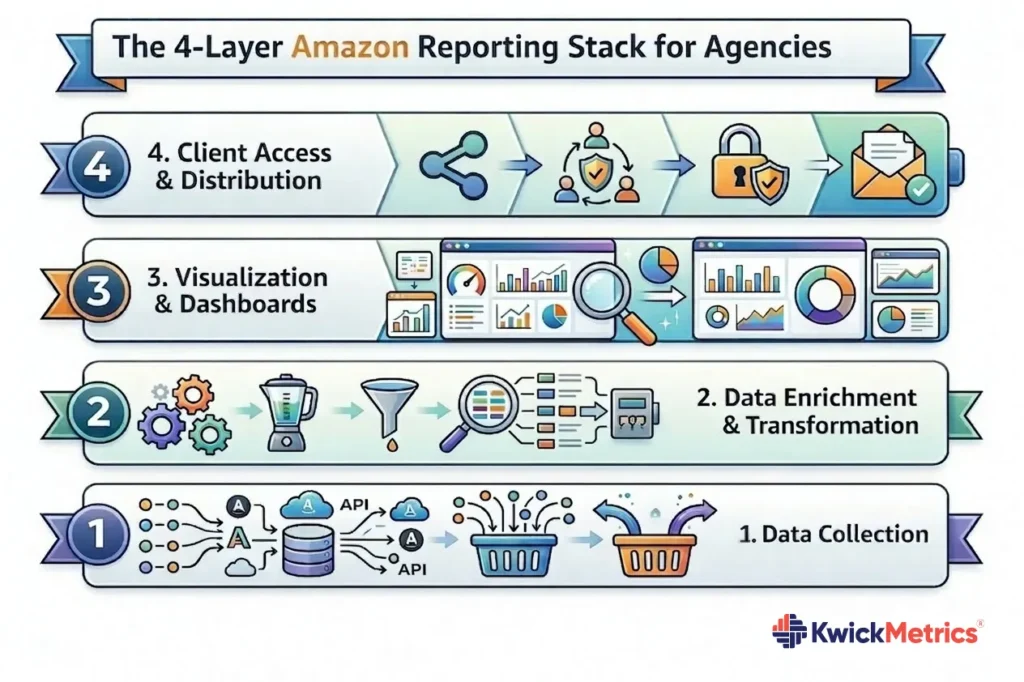
Layer 1: Data Collection
What it does: Connects to Amazon Seller Central, Amazon Advertising API, via official APIs to extract sales, traffic, ads, inventory, fees, refunds, and returns data.
Key capabilities:
- Direct API integration – Not web scraping, which violates terms of service and produces unreliable data
- Real-time or hourly sync – Near real-time data updates during high-volume periods (Prime Day, Black Friday)
- Historical retention – 12-24+ months of data for year-over-year trend analysis
- Multi-marketplace coverage – Amazon US, CA, MX, UK, DE, FR, IT, ES, JP, AU + Walmart US
Agency requirement: Must support 50-100+ seller accounts under one master login with bulk authorization workflows.
Layer 2: Data Enrichment & Transformation
What it does: Joins data from disparate sources, applies business logic (COGS, custom costs), calculates derived metrics (TACoS, contribution margin, customer LTV), and detects anomalies.
Key capabilities:
- SKU-level profitability – Complete P&L calculation: Revenue – COGS – All fee types – Ad spend – Returns = True profit
- Custom formulas – Agency-specific KPIs beyond standard Amazon metrics
- Data blending – Combines Amazon Ads data with Seller Central data with Walmart data into unified tables
- Anomaly detection – Flags Buy Box losses, inventory alerts, ASIN suppressions, unusual fee spikes
Agency requirement: Customizable cost structures per client (different COGS, fee negotiations, agency commission models).
Layer 3: Visualization & Dashboards
What it does: Presents enriched data through interactive dashboards with charts, tables, scorecards, and drill-down capabilities.
Key capabilities:
- Dashboard builder – Drag-and-drop interface to create custom views
- Pre-built templates – Industry-standard agency dashboards for common use cases
- Drill-down navigation – Click from portfolio, client, marketplace, ASIN, keyword level
- Mobile responsive – Clients can view dashboards on any device
Agency requirement: Complete white-label Amazon reporting software (logo, colors, fonts, custom domain) with zero tool branding visible to clients.
Layer 4: Client Access & Distribution
What it does: Delivers insights to clients through automated emails, PDF exports, live login portals, Slack alerts, or scheduled reports.
Key capabilities:
- Automated scheduling – Set-and-forget daily, weekly, or monthly report generation
- Client portals – Self-service login access where clients can explore data 24/7
- Multiple formats – PDF, Excel, CSV, live dashboard links
- Smart alerts – Email notifications when thresholds are breached
Agency requirement: Unlimited client user seats without per-seat pricing penalties that make scaling expensive.
8 Must-Have Features for Amazon Agency Reporting Tools
Based on interviews with Amazon agencies and analysis of 20+ platforms, here are the non-negotiable features agencies need when evaluating reporting tools.

Feature 1: Multi-client Amazon dashboard
What it means: One login to view all 20, 50, or 100+ client accounts in a unified interface with portfolio-level visibility.
Why it matters: Agencies report spending 3-5 hours per week just logging in and out of individual Seller Central accounts. Multi-client Amazon dashboard eliminates this completely. More importantly, you can spot trends across your entire client portfolio which clients are underperforming, which categories are seeing seasonal shifts, where to focus your team’s attention.
What to look for:
- Portfolio-level performance summary (all clients on one screen)
- Drill-down capability: Portfolio, Client Marketplace, Category, ASIN, Keyword
- Role-based permissions (account managers only see assigned clients)
- Client-specific performance targets and YoY benchmarks
- Bulk operations (apply changes across multiple accounts simultaneously)
Red flag: Tools that charge per account or limit account count by pricing tier, forcing you into expensive upgrades as you grow.
KwickMetrics advantage: Unlimited accounts under flat-rate agency pricing with a purpose-built multi-client Amazon dashboard interface designed for portfolio management.
Feature 2: Cross-Marketplace Reporting (Amazon + Walmart)
What it means: Unified analytics across all Amazon marketplaces (US, CA, MX, UK, DE, FR, IT, ES, JP, AU) and Walmart within one platform.
Why it matters: Forty-seven percent of Amazon sellers also sell on Walmart, but reconciling performance manually consumes 10+ hours per week per client. Amazon uses ASINs, Walmart uses SKUs/Item IDs and matching them in spreadsheets breaks every time clients add products. Double-counting ad spends across Amazon Ads and Walmart Connect makes ROAS calculations meaningless.
What to look for:
- Single SKU-level P&L showing profitability across both marketplaces
- Consolidated ads spend and ROAS (Amazon Ads + Walmart Connect combined)
- Side-by-side marketplace comparison views (which performs better for specific products)
- Unified inventory tracking across channels
Red flag: Amazon-only tools that force you to manage Walmart through a completely separate system with manual data reconciliation.
KwickMetrics advantage: Native Amazon + Walmart support under one platform with intelligent SKU matching algorithms that handle parent-child variation relationships.
Feature 3: White-label Amazon reporting software
What it means: Customize all reports and dashboards with your agency logo, colors, fonts, and branding before sharing with clients. Remove all third-party tool branding completely.
Why it matters: Generic tool-branded PDFs undermine your agency’s positioning. When clients see “Powered by [Tool Name]” footers, they perceive the tool as doing the work, not your expertise. Smart clients will search for the tool, discover it costs $100/month, and question your value. White-label reporting positions you as a technology-enabled strategic partner, not a middleman reselling someone else’s software.
What to look for:
- Complete logo and color scheme customization
- Custom logins for clients to view the report in understandable format
- Ability to add custom agency commentary and insights
- PDF exports with only your branding visible
- Option to create custom KPI definitions with your terminology
Red flag: Tools that limit white-labeling to enterprise tiers, charge extra for branding removal, or leave subtle tool identifiers in client-facing reports.
KwickMetrics advantage: Full white-label Amazon reporting software included at agency tier with no upcharges. Custom domain, complete branding control, and zero third-party identifiers.
Feature 4: Amazon Agency (SKU-Level) profitability tracking
What it means: Calculate true contribution profit per SKU after accounting for COGS, all Amazon/Walmart fee types, ad spend, refunds, returns, and reimbursements.
Why it matters: Amazon-related costs now consume 50%+ of seller revenue when all fees are included. Sellers and agencies consistently report that basic profit tools miss 10-15% of actual costs by only subtracting standard FBA fees while ignoring aged inventory surcharges, low inventory fees, inbound placement fees, storage fees, and unreimbursed losses.
The most important client question is: “Which products should we invest in, and which should we discontinue?” You can’t answer without true SKU-level profitability that accounts for every cost.
What to look for:
- COGS input at SKU or product group level
- Automatic calculation of ALL FBA fee types (not just basic fulfillment):
- Pick & pack fees
- Weight handling fees
- Monthly storage fees
- Long-term storage fees
- Aged inventory surcharges
- Low inventory level fees
- Inbound placement service fees
- Removal order fees
- Disposal order fees
- Ad spend attribution at ASIN level (not just account level)
- Refund and return processing cost tracking
- Reimbursement auditing for lost/damaged inventory
- TACoS calculation (Total Advertising Cost of Sale)
Red flag: Tools that show “profit” but only subtract base FBA fees, requiring you to manually track 5-10 other fee types in spreadsheets.
KwickMetrics advantage: Complete P&L at SKU level with all Amazon/Walmart fee types automatically tracked, COGS management, and built-in reimbursement auditing.
Feature 5: Automated Report Scheduling & Distribution
What it means: Set up weekly or monthly client reports that automatically generate and distribute via email or client portal without any manual work.
Why it matters: Agencies spend 25% of operational time crafting weekly client reports. For a 50-client agency, that’s 175 hours per week. AI-powered report automation can reduce this by 60%, freeing your team to focus on strategy, optimization, and client growth instead of PowerPoint assembly.
What to look for:
- Scheduled report generation (daily, weekly, monthly, custom)
- Preview capability before automated sending
- Email delivery with PDF attachment
- Client login portal where clients can access reports 24/7 without requesting them
- Customizable report templates per client type or industry
- Anomaly alerts that trigger immediate notifications (not just scheduled reports)
Red flag: Tools that require manual export and email every reporting cycle, or charge extra for scheduling features.
KwickMetrics advantage: Full report automation included with unlimited scheduled reports, client portals, and proactive anomaly alerting.
Feature 6: Real-Time Data Sync
What it means: Data updates hourly or every 2-4 hours, not once per day. During critical periods (Prime Day, Black Friday, product launches), you need real-time visibility.
Why it matters: When a client’s ad budget runs out at 10 AM on Prime Day, you need to know immediately not when tomorrow’s report generates. When Buy Box percentage suddenly drops from 98% to 45%, waiting 24 hours to discover the issue means lost sales you can’t recover.
What to look for:
- API-based integration (not web scraping, which violates Amazon TOS and produces unreliable data)
- Data freshness indicator showing last sync timestamp
- Hourly sync for sales and advertising data during peak periods
- Real-time inventory alerts for stockout risks
- Historical data retention for trend analysis (12-24+ months)
Red flag: Tools with 24-hour+ data lag, manual CSV upload requirements, or web scraping methods that risk account suspension.
KwickMetrics advantage: Hourly data sync via official Amazon and Walmart APIs with real-time inventory and performance alerts.
Feature 7: Proactive Rulesets & Alerts
Why it matters: An Amazon agency expert captured this perfectly: “You never want to be in a situation where the client finds an issue before you do.” Agencies consistently report losing clients when competitors conduct better audits and surface problems the incumbent agency missed.
Proactive diagnostics transform reporting from a rear-view mirror (what happened last week) into a strategic early-warning system (fix this today before it becomes a crisis).
What to look for:
- Configurable alert thresholds per client
- Multiple notification channels (email, SMS, dashboard)
- Alert types:
- ACOS alert, can set rules for personalized
- Ads based alert
- Inventory stockout warnings (7-day, 14-day runway)
- Ad budget pacing problems (overspend or underspend)
Red flag: Tools with no alerting system, requiring manual daily checks across 30+ clients to spot issues.
KwickMetrics advantage: Comprehensive suite of proactive diagnostics with customizable alert thresholds per client and multi-channel notifications.
Feature 8: Transparent, Scalable Pricing
What it means: Flat-rate or account-based pricing that doesn’t penalize agency growth, with transparent published rates.
Why it matters: Per-account pricing models become prohibitively expensive as agencies scale. A tool charging $50 per account costs $2,500/month for 50 clients — often exceeding your profit margin on smaller accounts. Hidden fees for white-labeling, client user seats, or data exports further erode profitability.
What to look for:
- Transparent per-account pricing with volume discounts
- No hidden fees for white-labeling, branding removal, or client access
- Unlimited user seats (not per-seat pricing that limits team growth)
- Clear data export policies (not holding your data hostage)
Red flag: Tools that charge separately for basic features like white-labeling.
KwickMetrics advantage: Transparent pricing published on website, tiers with unlimited client accounts, no per-seat penalties, customized pricing based on agency needs.
How to Choose the Right Amazon Reporting Tool for Your Agency
The right tool depends on your agency size, client marketplace mix, internal capabilities, and budget. Use this framework to evaluate options.
By Agency Size
Agencies with 1-10 clients: At this stage, multi-account management and white-label reporting are valuable but not critical. Your biggest risk is choosing per-account pricing that becomes expensive as you grow. Starting with flat-rate pricing future-proofs your infrastructure based on budget-conscious or growth-ready options based on your plan.
Agencies with 10-50 clients: Multi-account dashboards and automated reporting become non-negotiable at this scale. Managing 30 clients across separate logins wastes 10+ hours per week. Per-account pricing models break your budget $50/account, 30 clients = $1,500/month, often more than your profit margin on smaller accounts.
Agencies with 50+ clients (enterprise): At enterprise scale, flat-rate pricing is mandatory. You also need advanced features like API access for custom integrations, dedicated account management, and potentially Amazon Marketing Cloud integration for sophisticated attribution.
By Client Marketplace Mix
Amazon-only clients: Focus on depth of Amazon-specific features AMC integration capability, reimbursement auditing, Seller Central API coverage.
Amazon + Walmart clients: Native unified Amazon + Walmart reporting. Some solution requires two separate tools with manual data reconciliation 10+ hour weekly time sink that creates error-prone reporting.
Multi-marketplace (Amazon global + Walmart): Need consolidated reporting across 10+ Amazon marketplaces (US, CA, MX, UK, EU, JP, AU) plus Walmart under one interface. Currency conversion, VAT handling, and cross-border inventory tracking become critical.
By Internal Capabilities
No dedicated data team: Need turnkey, pre-built dashboards and automated reporting that works out-of-the-box. Avoid data warehouse + BI tool combinations that require SQL knowledge, data engineering, and ongoing technical maintenance.
Data analysts in-house: Maximum flexibility to build custom data models and blend Amazon performance with other marketing channels (Google Ads, Facebook, TikTok, CRM, email marketing). Trade-off is 2-4 weeks setup time and ongoing maintenance overhead.
By Budget
Under $200/month: Limited white-labeling, basic profitability tracking, manual report generation, no client portals. Acceptable if you’re just starting or managing fewer than 5 small clients.
$200-500/month: Full agency features (multi-account, white-label, automation, profitability, alerts) at predictable flat rate. Best value for agencies managing 10-50 clients.
$500+/month or custom pricing: 30+ clients, need Amazon Marketing Cloud integration, require deep customization, or have complex multi-brand portfolio structures.
Why KwickMetrics Is the Amazon Reporting Tool Built for Agencies
KwickMetrics is the only reporting platform purpose-built from the ground up for agencies managing Amazon and Walmart seller accounts at scale. Here’s how it addresses every requirement from this guide.
Built for Multi-Client Management from Day One
Unlike tools retrofitted for agencies, KwickMetrics’ interface was designed for portfolio-level visibility. One login provides access to unlimited client accounts. View consolidated performance across your entire portfolio, then drill down: Portfolio, Client Marketplace, Category, ASIN, Keyword.
Role-based permissions ensure account managers only see their assigned clients, while leadership maintains full visibility. Team activity logs track changes across all accounts for quality control and training.
Native Amazon + Walmart Unified Reporting
KwickMetrics offers true cross-marketplace consolidation. Intelligent SKU matching automatically links Amazon ASINs with Walmart Item IDs, handling parent-child variations and product bundles correctly.
View consolidated P&L across both marketplaces, compare performance side-by-side, and calculate true advertising efficiency with combined ad spend from Amazon Ads and Walmart Connect. No manual spreadsheet reconciliation required.
Complete SKU-Level Profitability
True contribution profit calculated after:
- COGS (cost of goods sold) at SKU or product group level
- All Amazon/Walmart fee types including aged inventory surcharges, low inventory fees, inbound placement fees
- Ad spend attribution at ASIN level
- Refund and return processing costs
- Reimbursement auditing for lost/damaged FBA inventory
This eliminates the profitability blind spots that plague generic tools, giving you confidence when advising clients on product investment decisions.
White-Label Reporting & Client Portals
Complete branding customization puts your agency front and center:
- Custom logo, colors, and fonts throughout
- Custom domain (reports.youragency.com)
- Automated report scheduling with email delivery
- Self-service client login portals for 24/7 access
- Zero third-party branding visible to clients
Clients see your expertise and technology, not a third-party tool they could buy directly.
Proactive Diagnostics & Alerts
Customizable alerts catch issues before clients notice:
- ASIN suppression or listing problems
- Inventory stockout warnings (7-day, 14-day runways)
- Ad budget pacing issues (overspend or underspend)
- Unusual fee charges
Email and dashboard notifications ensure your team responds immediately, transforming reporting from reactive to proactive client management.
Transparent Agency Pricing
:Flat-rate agency tiers with unlimited client accounts to eliminate the per-account pricing trap. As you grow from 10 clients to 50 clients, your reporting cost remains predictable for no exponential price increases that eat profit margins.
All features included at agency tier: white-labeling, unlimited users, client portals, API access, proactive alerts, no hidden fees.
See KwickMetrics in action Request a personalized demo for your agency
Amazon Reporting Tool Decision Matrix
Use this quick-reference matrix to finalize your decision based on your specific situation.
For agencies managing both Amazon and Walmart accounts (or planning to expand to Walmart), KwickMetrics is the only platform that eliminates the need for two separate reporting tools while offering:
- Full white-label automation
- SKU-level profitability with all fee types
- Unlimited account scalability at flat-rate pricing
- Native cross-marketplace consolidation
- Proactive diagnostics that catch issues first

Agency Action Plan
Step 1: Audit your current reporting process
- How many hours per week does your team spend generating client reports?
- Calculate true cost: Hours blended hourly rate = weekly reporting expense
- Identify your biggest pain points: manual work, data accuracy, client satisfaction?
Step 2: Define your must-haves feature
- How many clients do you manage now? In 12 months?
- Do clients sell on Walmart or plan to expand there?
- Is white-label reporting critical for your positioning?
- What’s your budget range?
Step 3: Request demos from 2-3 finalists
- Show them your actual use case, not hypothetical scenarios
- Ask: “How do you handle [your specific challenge]?”
- Test the interface yourself does it feel intuitive?
- Request client portal access to see the end-user experience
Step 4: Calculate ROI
- Time savings: 60% reduction per seller in reporting current cost = savings
- Client retention: What’s one saved client worth annually?
- Growth enablement: How many more clients can you serve with freed capacity?
Ready to eliminate 175+ hours of manual reporting per week and transform your agency’s reporting from cost center to competitive advantage?
Book your KwickMetrics agency demo
Get Your Questions Answered (FAQ)
Amazon Brand Analytics (free with Brand Registry) offers basic insights like search terms and conversion share but lacks multi-account reporting, profitability tracking, and Walmart support. Third-party tools like KwickMetrics transform raw data into smart analytics, helping agencies make better decisions and clearly demonstrate value to clients.
For agencies reporting tools like KwickMetrics, don’t just optimize ads—they clearly demonstrate total business impact to clients, improving trust and long-term retention.
Most tools support only Amazon, forcing agencies to manage Walmart separately, and spending hours on manual reconciliation. KwickMetrics unifies both marketplaces in one view, saving time and helping agencies scale operations without complexity.
Tools connect via Amazon's official SP-API (Selling Partner API) and Advertising API after you grant secure account access. This pulls sales, traffic, inventory, fee, and ad performance data into the tool's database for analysis.
The integration is read-only (tools can't make changes to your account), and you can revoke access anytime. No manual CSV uploads required everything syncs automatically via API.
Look for tools with:
- Dashboard - Allows you to build custom dashboards based on the requirement
- Data export - Ensures you're not locked in and can move data to other systems
- Active roadmap - Tools that regularly ship new features based on customer feedback.
Initial setup takes just a few minutes, with the ability to onboard multiple client accounts quickly. This means agencies spend less time on setups and more time driving strategies, growth, and profitability for their clients.


Jyothishwari Mohanan is a Senior Content Strategist at KwickMetrics, where she crafts content that helps Amazon and Walmart sellers & agencies navigate the complexities of eCommerce with confidence. With 8+ years of experience across Retail and SaaS brands, she specializes in translating product capabilities into clear, compelling narratives that resonate with real sellers. She works closely with eCommerce teams, digs into seller challenges firsthand, and shapes content that drives both understanding and action.