Amazon Product Title Guidelines Changed — Don’t Let Amazon Rewrite Your Listings Before July 27
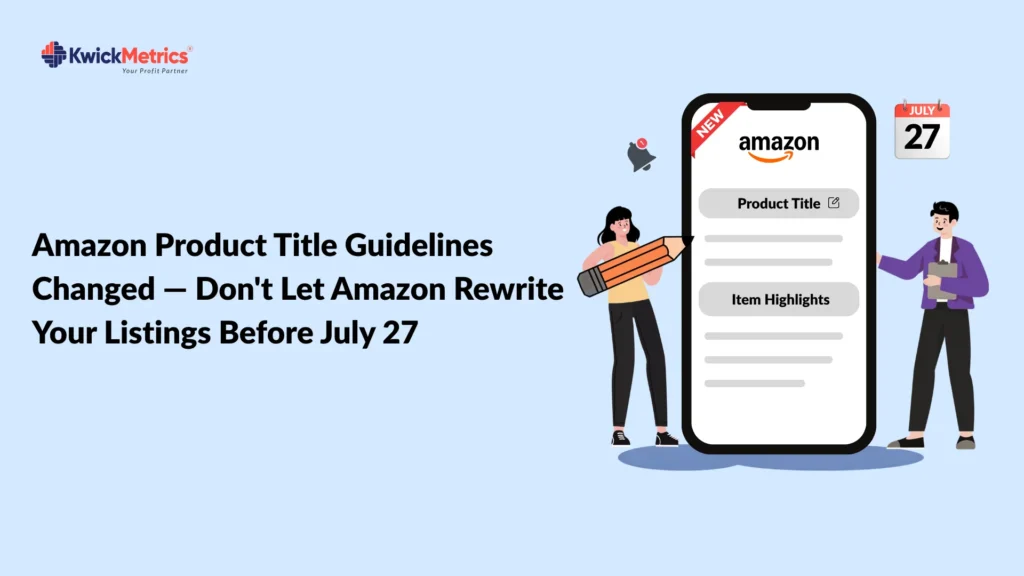
Table of Contents
- Introduction
- Amazon Product Title Limit Updated From 200 to 75 Characters
- What Happens When Amazon Rewrites Your Product Title
- KwickMetrics Preserves Your Amazon Product Rankings
- For Agencies — Turn the Deadline Into a Deliverable
- Fix Every Amazon Product Title Free — Before July 27
- Get Your Questions Answered (FAQ)
Introduction
You have until July 27 to fix your Amazon product titles. After that, Amazon’s AI takes over, and it does not ask for your input before rewriting them.
That means the keyword order you tested over months, the brand copy that separates your listing from dozens of near-identical competitors, the conversion language you refined through trial and error — all of it gets replaced by an algorithm optimizing for its own compliance logic, not your rankings or your buyers.
Amazon is not sending warnings this time — it is sending rewrites. Titles over 75 characters get added to the rewrite queue automatically. There is no appeal window for most sellers. There is no preview before it goes live.
Here is what changed, what is at stake for sellers and agencies managing large catalogs, and how to fix every title before July 27 — for free.
Key takeaway:
- Amazon is cutting the product title character limit from 200 to 75 characters, with a hard enforcement date of July 27, 2026
- A new “Item Highlights” field (125 characters) replaces overflow content — and it indexes in Amazon’s search
- Non-compliant titles will be gradually rewritten by Amazon’s AI after the deadline; brand owners get a 14-day review window before changes go live
- Sellers with 100+ ASINs and agencies managing multiple accounts face the biggest operational burden — manual fixes won’t close the gap in time
- Bulk title compliance across your entire catalog is achievable before the deadline — without manual editing at the ASIN level
Amazon Product Title Limit Updated From 200 to 75 Characters
From July 27, every product title must stay within 75 characters. The remaining content moves to a new field called Item Highlights — 125 characters that display directly beneath the title in search results and are fully indexable. Together, they still give you 200 characters of searchable content. The structure hasn’t shrunk — it’s been split.
The updated amazon product title guidelines also restrict keyword stuffing, repeated words, and most special characters. July 27 is when these stop being recommendations and become automatic enforcement.
One thing to keep in mind: your longer titles are still working for you until the deadline. The goal is to have compliant titles ready to publish before July 27 — not to cut everything early and lose keyword coverage in the meantime.
What Happens When Amazon Rewrites Your Product Title
Amazon’s AI rewrites are optimized for its algorithm, not your buyer. When it rewrites a title, you lose:
- Keywords you’ve tested and placed deliberately — word order matters for ranking, and the rewrite won’t replicate your sequence
- Brand voice and the conversion copy that differentiates your listing from a dozen near-identical products
- The listing copy you’ve refined over time to win clicks and conversion
For a seller with 20 ASINs, this is manageable. For a seller with 200 ASINs, it’s months of ranking and conversion data quietly discarded by an automated process that didn’t ask for input.
Rankings you’ve built over months — through careful keyword placement, bid adjustments, and conversion testing don’t transfer automatically to a rewritten title. Amazon’s AI rewrites for algorithmic compliance, not for your ranking history. Once it rewrites, you start over.
For agencies, the scale problem is even sharper. A team managing 10 to 15 seller accounts, each with 50 to 200 ASINs — is facing anywhere from 1,000 to 3,000 individual title rewrites before the deadline. Done manually, that’s not a sprint. It’s a month of work, assuming nothing else is on the roadmap.
KwickMetrics Free Amazon AI Title Optimizer

The KwickMetrics Amazon AI Title Optimizer is built specifically for this problem — handling amazon product title optimization across your entire catalog in bulk at a time, not one listing at a time
The workflow is three steps: Scan → Convert → Publish.
- Scan your full catalog to identify every title that exceeds 75 characters or violates the updated guidelines
- Convert non-compliant titles automatically, distributing content correctly between the new Title field and Item Highlights
- Publish the updated titles directly from KwickMetrics — no need to go back into Seller Central
At the review stage, you see a side-by-side comparison of the original title and the optimized version — along with how the content has been split between the Title field and Item Highlights. For agencies, this view exports as a before/after CSV per client, ready for sign-off before anything goes live.
Once your titles are live, you can track CTR and CVR performance using KwickMetrics to see exactly how the optimized titles are impacting clicks and conversions over time.
It’s free to use. No plan required. No Credit Card Required. For sellers and agencies sitting on hundreds of ASINs with a fixed deadline approaching, that matters.
KwickMetrics Preserves Your Amazon Product Rankings
The most common concern sellers raise: “Will shortening my title hurt my rankings?”
The answer is no — if the content moves to the right place.
KwickMetrics pairs the compliant 75-character title with a properly constructed Item Highlights field. The full 200 characters of indexable content stays intact. Keywords don’t disappear — they get redistributed correctly between the two fields, the way Amazon’s updated structure intends.
What would hurt rankings is letting Amazon’s AI handle the redistribution. It doesn’t have access to your Brand Analytics data, your search-term reports, or your historical ranking signals. It compresses based on its own logic.
KwickMetrics does it based on your existing keyword structure — your search term reports, your ranking history, your Brand Analytics data. That distinction matters when you have 500 ASINs and a hard deadline.
For Agencies — Turn the Deadline Into a Deliverable
An agency managing 15 seller accounts — each with 80 to 200 ASINs — is looking at 1,500 to 3,000 individual title rewrites before July 27. Done manually, that’s a month of work across the team.
KwickMetrics already reduces manual reporting work by ~60% per seller for agencies managing at scale — the Title Optimizer applies the same logic to compliance: eliminate the per-ASIN manual loop entirely and give your team time back for work that actually moves client metrics.
With KwickMetrics Amazon AI Title Optimizer, the entire catalog across all 15 accounts gets scanned and bulk-converted in one session. The team reviews and approves, exports a before/after CSV per client for sign-off, then publishes the updated titles directly from the tool — no need to go back into Seller Central. What was a fire drill becomes a structured, client-facing deliverable — and a legitimate line item on the invoice.
Compliance work that used to be overhead becomes a billable service. And agencies that deliver it cleanly before the deadline build the kind of credibility that retains clients — because they acted when others were still waiting to see what happened.
Fix Every Amazon Product Title Free — Before July 27
The deadline isn’t a soft target. After July 27, every non-compliant Amazon product title gets added to Amazon’s rewrite queue — and Amazon’s AI doesn’t ask for input before it changes your listings.
The window to fix this on your own terms is open right now. For sellers and agencies who act before the deadline, the before/after CSV is a clear record of what was done. For those who wait, the record belongs to Amazon’s algorithm.
Try KwickMetrics Amazon AI Title Optimizer Free
Scan your entire catalog before July 27.
Get Your Questions Answered (FAQ)
Keep your title within 75 characters, lead with your brand and top keyword, and move secondary descriptive content into the Item Highlights field. Focus on clarity — the title should tell a shopper immediately what the product is. For large catalogs, KwickMetrics Amazon AI Title Optimizer handles the scan, conversion, and bulk publish in one workflow — free to use.
From July 27, Amazon limits product titles to 75 characters. The remaining content belongs in the new Item Highlights field — 125 characters that appear directly beneath the title in search results and are fully indexable. Think of it as a two-part title: the core product identity in 75 characters, and the supporting detail in the 125-character field below. Your total searchable content stays at 200 characters
Titles must stay within 75 characters with no keyword stuffing, repeated words, or special characters. Use this format: Brand + Product type + Key attributes — secondary keywords belong in Item Highlights.
KwickMetrics gives you full visibility into what changed across each client's catalog. You can walk clients through exactly what was updated and why. On top of that, KwickMetrics tracks CTR and CVR performance post-optimization — so you're not just showing clients what changed, you're showing them the impact it had on clicks and conversions. That turns a compliance task into a measurable, client-facing deliverable that reinforces your agency's value.
The product listing scan and conversion happen in a single session. Your team reviews, makes adjustments, and publishes — timeline depends on catalog size and review depth, but the manual work is eliminated regardless of how many ASINs you're managing.
No — as long as your keywords move to the right place. Keep your primary keywords in the 75-character title where they carry the most ranking weight. Secondary keywords belong in Item Highlights, which is fully indexable and appears directly in search results.
KwickMetrics preserves your existing keyword structure when it converts the title — placing content correctly across both fields so your search visibility stays intact.
Yes. KwickMetrics lets you scan, convert, and publish title changes across your entire client portfolio from a single dashboard — no account-switching, no missed ASINs. Once published, you can track CTR and CVR performance per client directly within KwickMetrics, turning a compliance task into a measurable, billable deliverable.


Jyothishwari Mohanan is a Senior Content Strategist at KwickMetrics, where she crafts content that helps Amazon and Walmart sellers & agencies navigate the complexities of eCommerce with confidence. With 8+ years of experience across Retail and SaaS brands, she specializes in translating product capabilities into clear, compelling narratives that resonate with real sellers. She works closely with eCommerce teams, digs into seller challenges firsthand, and shapes content that drives both understanding and action.