How to plan your Amazon peak season inventory without losing your profit margin
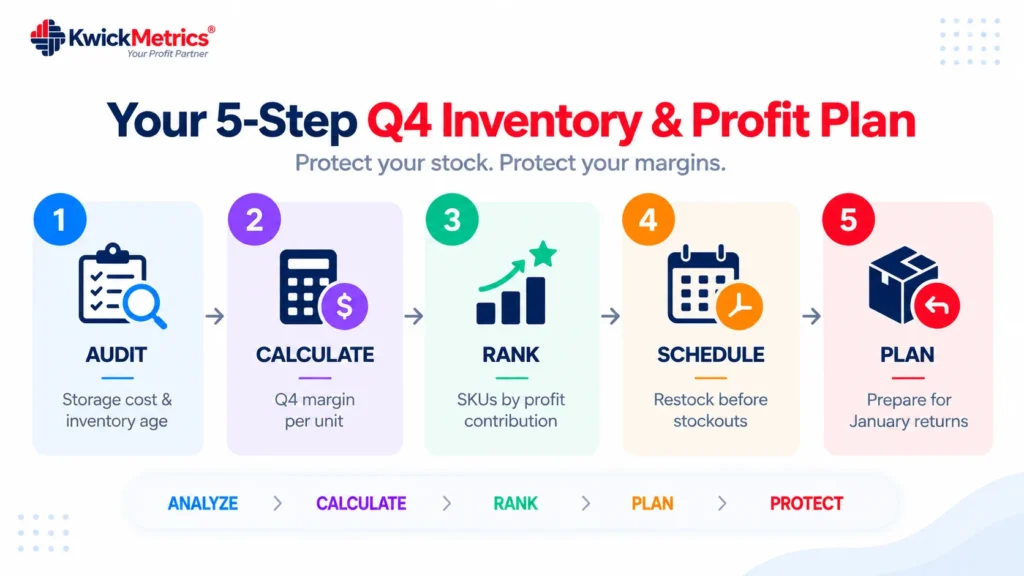
Table of Contents
- What you need before you start
- Step 1: Audit every SKU's current storage cost and age
- Step 2: Calculate your per-unit amazon peak season margin
- Step 3: Set restock quantities using margin-weighted demand
- Step 4: Lock in your restock calendar against Amazon deadlines
- Step 5: Plan for January before November arrives
- Step 5: Plan for January before November arrives
- Where to start
- Get Your Questions Answered (FAQ)
The base monthly storage fee for standard-size items jumps from $0.78 to $2.40 per cubic foot the moment October begins (as of 2026, per Amazon’s published fee schedule). Add the aged inventory surcharge at 181 days and a per-unit holiday peak fulfillment fee. A product clearing $3.20 per unit in September can drop below breakeven in November — while your dashboard still shows record revenue.
Your amazon profit margin on every SKU changes when peak fees hit. Recalculate before you restock, rank by margin not volume, and set a liquidation trigger for anything that does not sell through.
What you need before you start
Three things: your Inventory Age report (Seller Central → Inventory Planning → Inventory Age), your per-SKU profit breakdown after all fees, and Amazon’s 2026 fee schedule (fee update page). Pulling per-unit amazon fba profit margin manually means downloading settlement reports and matching every fee line by SKU. KwickMetrics does that math automatically — the P&L by product view shows per-unit margin for every connected account.
Step 1: Audit every SKU's current storage cost and age
Sort your Inventory Age report into three groups:
| Group | Days in warehouse | Action |
|---|---|---|
| Safe | Under 90 days | No surcharge risk. Evaluate restock normally |
| Watch | 90–180 days | Will hit the 181-day surcharge during Q4 if velocity does not increase |
| Surcharge zone | 181+ days | Already accruing surcharges. Decide: liquidate, remove, or promote |
The aged inventory surcharge starts at $0.50 per cubic foot at 181 days and climbs to $6.90 per cubic foot past 365 days (as of 2026, per Amazon’s fee schedule). That stacks on top of the $2.40 Q4 base rate — combined cost at 271+ days exceeds $7.85 per cubic foot. Remove or liquidate slow inventory before October, not after.

Step 2: Calculate your per-unit amazon peak season margin
Your September margin is not your November margin. Here is the math for a standard-size product occupying 0.35 cubic feet:
| Fee component | Off-peak (Sep) | Peak (Nov) |
|---|---|---|
| Monthly storage per unit | $0.78 × 0.35 = $0.27 | $2.40 × 0.35 = $0.84 |
| Holiday peak fulfillment fee | $0.00 | ~$0.32 per unit |
| Total fee increase per unit | — | +$0.89 |
On a product with a $3.50 per-unit margin in September, November margin drops to $2.61 — a 25% reduction before higher ad costs. If a SKU’s Q4 margin drops below $1.00 after all fees, raise the price, cut ad spend, or skip the restock. The amazon fba storage fees breakdown covers every fee category.
Step 3: Set restock quantities using margin-weighted demand
Standard amazon inventory management restocks by velocity. But a product selling 10 units a day at $0.80 margin after Q4 fees is a worse candidate than one selling 4 units a day at $4.50 margin. Rank by total margin contribution, not volume:
- Pull your trailing 30-day and 90-day daily sales rate. Use whichever is higher.
- Multiply by supplier lead time plus 14 days of safety stock.
- Multiply that quantity by your Q4 per-unit margin (from Step 2).
- Rank all SKUs by total margin contribution. Send highest first.
For agencies, this ranking answers the question every client asks — “what should I restock?” — with a number attached to each SKU. Run it per client account. Each catalog has different COGS and velocity patterns.
Step 4: Lock in your restock calendar against Amazon deadlines
Work backward from these dates:
| Event | Approximate date (2026) | Last safe ship date |
|---|---|---|
| Prime Big Deal Days | Mid-October | September 15 |
| Black Friday / Cyber Monday | November 27–30 | October 20 |
| Holiday gifting cutoff | December 20 | November 15 |
“Last safe ship date” means arrival at the FC, not shipment creation. The most expensive Q4 mistake is emergency air freight to fix a stockout — it costs 4–6× sea freight and wipes the margin you calculated in Step 2. KwickMetrics’ inventory management tools track days of supply against sales velocity so you see approaching stockouts before you need rush shipping.
Step 5: Plan for January before November arrives
Returns from November and December sales hit your warehouse through late January. Each returned unit cost you fulfillment fees and now sits accruing storage — at the surcharge rate if it was already aging. Before finalizing restock quantities: check your category’s historical return rate (above 10%? reduce quantities) and set a removal trigger for any SKU below target sell-through by December 15.
For more on clearing slow inventory, the 9 inventory management strategies guide covers liquidation and dead-stock tactics.
Step 5: Plan for January before November arrives
Returns from November and December sales hit your warehouse through late January. Each returned unit cost you fulfillment fees and now sits accruing storage — at the surcharge rate if it was already aging. Before finalizing restock quantities: check your category’s historical return rate (above 10%? reduce quantities) and set a removal trigger for any SKU below target sell-through by December 15.
For more on clearing slow inventory, the 9 inventory management strategies guide covers liquidation and dead-stock tactics.
Where to start
Pull your Inventory Age report and per-SKU profit breakdown today. Start with the five SKUs that represent the most capital in your warehouse. Run the fee math from Step 2. If the Q4 margin holds, restock using the margin-weighted ranking in Step 3. If it does not, decide now: raise price, cut ad spend, or skip the restock. For agencies, repeat per client account.
Every account in one place, no per-account fees, no separate logins.
Get Your Questions Answered (FAQ)
Peak storage rates run October 1 through December 31 — standard-size items jump from $0.78 to $2.40 per cubic foot. The holiday peak fulfillment fee (~$0.32 per unit) applies mid-October through mid-January. Both stack on top of any aged inventory surcharges.
Calculate per-unit margin at Q4 fee rates, not current rates. Subtract peak storage, the holiday surcharge, and expected ad spend. Below $1.00 per unit? The restock may not justify the capital or the risk of unsold units entering the surcharge window.
Run the margin calculation (Step 2) and margin-weighted ranking (Step 3) per client account separately. Each catalog has different COGS, fee structures by size, and velocity patterns. The holiday peak fee guide walks through the per-unit surcharge in detail.


Karthick Selvaraj is a Product Manager at KwickMetrics, where he leads the development of data-driven tools that help Amazon and Walmart sellers track profitability, optimize ads, and manage their business with greater clarity and control. He works closely with eCommerce brands, presents at industry events, and turns real seller pain points into intuitive product features.