Amazon Holiday Returns Keep Moving Q4 Profit After Your Client Report
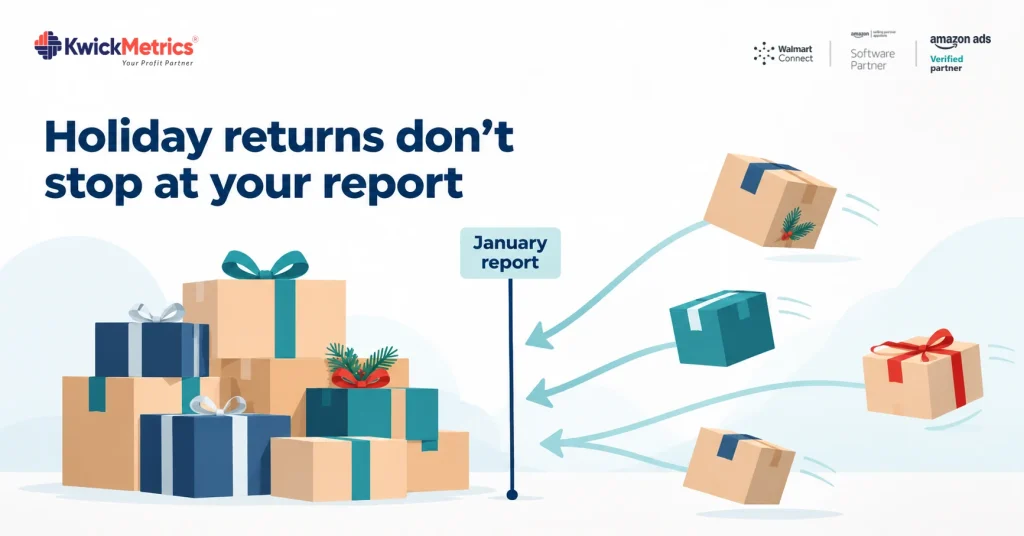
Table of Contents
The Q4 profit report you send clients in early January can still move. Amazon’s holiday return policy lets customers start returns on eligible items bought November 1 to December 31, 2026, until January 31, 2027, with exceptions such as Apple-brand items. Walmart’s windows start earlier and, for Walmart Fulfillment Services orders, can run longer. If your January number counts only the refunds posted so far, it overstates the holiday result once later returns come through.
The client sees a strong December and plans a bigger Q1 reorder around it. On one account, a later drop makes for an awkward call. Across 15 client accounts, it turns into a pattern clients notice. Below: where the gap comes from, its size, and a reporting method that keeps the open amazon return window visible until each cohort’s returns close.
Why holiday returns keep landing after your Q4 report
Holiday returns keep landing after a January report because the amazon holiday return policy keeps return windows open well into the new year. For most eligible items, Amazon’s holiday cutoff is January 31, 2027. Walmart’s seller-fulfilled cutoff is also January 31. WFS gives most items 90 days. Exceptions apply on both marketplaces.
Return windows table:
| Amazon (FBA & seller-fulfilled) | Walmart seller-fulfilled | Walmart WFS | |
|---|---|---|---|
| Holiday purchases | Nov 1 – Dec 31, 2026 | Most items Oct 1 – Dec 31 | Extended holiday window; length not stated |
| Return must start by | Jan 31, 2027 (Apple: Jan 15) | Jan 31 | 90 days for most items |
| Exceptions | Apple-brand items | Some electronics, appliances, consumables, seasonal/luxury | Most wireless phones, major appliances |
Amazon says the extended window “will apply every year,” with no seller action required. These dates are when a customer must start a return, not when your numbers settle. Some refunds are issued before the item arrives, others wait for transit and inspection, and some end in a dispute. Amazon’s holiday peak fulfillment fees run October 15, 2026 to January 14, 2027. A unit can carry a peak-rate fee and still be returned after the peak window ends.
Retailers expected 17% of 2025 holiday sales value to be returned, according to NRF and Happy Returns (October 2025). That is an all-retail, value-based figure, not a marketplace rate, and it does not say when returns arrive.
What a January number without a returns line can cost you
A January number that counts only refunds posted so far can overstate the holiday result by thousands of dollars per client. In the example below, the January 5 figure is $7,236 higher than the figure after the cohort’s amazon holiday returns are processed. That is 30.7% above the later figure, or a 23.5% drop from what was reported. This is a simplified contribution example, not a P&L. It assumes no returns reserve in the January 5 report.
Simplified contribution per unit (hypothetical):
| Line item | Amount |
|---|---|
| Sale price | $40.00 |
| Referral fee (15%, hypothetical) | −$6.00 |
| FBA fulfillment fee, peak period (hypothetical) | −$6.50 |
| COGS | −$12.00 |
| Ad spend per unit sold | −$6.00 |
| Contribution per unit sold | $9.50 |
$40.00 − $6.00 − $6.50 − $12.00 − $6.00 = $9.50. When the unit is refunded, the $9.50 contribution is lost and some costs stay. Refund administration fee: lesser of $5.00 or 20% of referral fee = $1.20 retained. Fulfillment fee not refunded. Ad spend unchanged. Returns processing, removal, and disposal fees set to $0 here. The example assumes each refund is full, single-unit, and that 70% of returned units are resellable.
Resellable return: −$1.20 − $6.50 − $6.00 = −$13.70, a swing of $9.50 + $13.70 = $23.20. Unsellable return: −$13.70 − $12.00 = −$25.70, a swing of $35.20. Blended at 70/30: (0.70 × $23.20) + (0.30 × $35.20) = $26.80 per return.
Holiday cohort contribution:
| Holiday cohort (Nov 1 – Dec 31) | Calculation | Contribution |
|---|---|---|
| 3,750 units ($150,000 sales), before returns | 3,750 × $9.50 | $35,625 |
| Jan 5 report: 180 refunded units, no reserve | $35,625 − (180 × $26.80) | $30,801 |
| After cohort returns processed: 450 units (12%) | $35,625 − (450 × $26.80) | $23,565 |
| Difference | $30,801 − $23,565 | $7,236 |
| Difference as % of later figure | $7,236 ÷ $23,565 | 30.7% |
| Drop as % of Jan 5 figure | $7,236 ÷ $30,801 | 23.5% |
The 12% is an illustrative unit rate, not comparable to NRF’s value-based 17%. A January number without a returns line is a draft and should be labeled as one.
How to report Q4 while returns are still open
Send a provisional Q4 report in January with an estimated returns reserve on its own line, then reconcile at a checkpoint once each cohort’s returns have largely closed. Label the January report “provisional: holiday returns still open.” Set a reconciliation checkpoint for each marketplace after its holiday return cutoff. WFS gives most items 90 days, so late-December WFS orders can come back into March.
Tie the reserve to each marketplace’s original holiday sales cohort: Amazon purchases from November 1 to December 31, Walmart seller-fulfilled from October 1, and WFS orders on their own window. Use last year’s matching cohort, measured after its returns closed, for the rate. Adjust for category, price, mix, or policy changes, and note the adjustment.

Remaining reserve = (cohort units × historical unit return rate − full-unit refunds already posted from the same cohort) × contribution lost per returned unit, floored at zero. In the example: (3,750 × 12%) − 180 = 270 units; 270 × $26.80 = $7,236. As amazon fba returns post, reduce the reserve so nothing is counted twice. Model partial refunds separately using their actual refund amounts, retained fees, and inventory outcome.
Rebuilding posted refunds and fees by hand means exporting each client’s transactions. KwickMetrics profit and loss views by account, product, category, and order start from sales minus refunds and include return fees, grouped by date range, for Amazon and Walmart. Use them for posted refunds and fees. Matching each refund to its original holiday order, the historical rate, and the reserve stays your team’s work, shown as a separate line.
Doing this across multiple client accounts
Across multiple client accounts, the risk is inconsistency, not arithmetic. If 15 clients each had the $7,236 gap from the example, $108,540 of reported holiday contribution could reverse. The fix is one standard: the same cohort definitions, reserve method, report labels, and checkpoints for every client.
Timeline:
| Date | Event | Applies to |
|---|---|---|
| Oct 1, 2026 | Holiday purchase window opens (most items) | Walmart seller-fulfilled |
| Oct 15, 2026 | Holiday peak fulfillment fees start | Amazon FBA |
| Nov 1, 2026 | Holiday purchase window opens | Amazon.com |
| Early Jan 2027 | Provisional Q4 report with reserve line | Your reporting calendar |
| Jan 31 | Holiday return cutoff | Amazon; Walmart seller-fulfilled |
| After each cutoff | Reconciliation checkpoint | Your reporting calendar |
| Per WFS window (90 days) | Separate reconciliation | Walmart WFS |
If each client’s reserve lives in its own spreadsheet, it hits the same problems described in our post on why weekly exports fall short as a client dashboard.
Reconciliation is the hardest part to scale, because each mismatch needs a reason, status, and policy check on every account. KwickMetrics’ fully managed reimbursement service for Amazon and Walmart covers customer-return cases such as lost returns, carrier damage, and incorrect refunds, with fees charged only on recovered funds. Walmart support applies to US-based Walmart accounts only. Treat its findings as one input to each checkpoint, and keep unresolved cases on the open list.
Where to start
Start with definitions, not the math. While the holiday return windows are open, document each client’s holiday cohorts: Amazon purchases from November 1 to December 31, Walmart seller-fulfilled from October 1, and WFS orders under their own window. Pull last year’s matching cohorts after their returns closed.
Add a reserve line and a “provisional” label to the January template. Tell clients before sending the report when you expect to update it. When each checkpoint arrives, release the reserve against full-unit refunds from the cohort and keep open items listed.
The reserve method works best when posted refunds and fees sit in one view across every client account.
Bring every client account under one login, no per-account fees.
Get Your Questions Answered (FAQ)
Customers must start returns on eligible 2026 holiday purchases by January 31, 2027. The window covers items bought on Amazon.com from November 1 to December 31, 2026, for FBA and seller-fulfilled orders. Apple-brand items are due by January 15, 2027. Amazon says the window will apply every year, and processing can continue after the cutoff.
Not entirely. For seller-fulfilled orders, Walmart says most items bought October 1 through December 31 are returnable until January 31, with exceptions for some electronics, appliances, and seasonal items. WFS orders follow a 90-day window for most items. Set separate checkpoints for each fulfillment type.
Present the change as a planned update, not a surprise restatement. Send a provisional January report with an estimated returns reserve on its own line. Reconcile at a checkpoint after each marketplace’s cutoff, replace the estimate with posted refunds, and list unresolved returns until they close. Formal accounting treatment stays with the client’s accountant.
Use last year’s matching holiday cohort, measured after returns closed, for the rate. Multiply this year’s cohort units by that rate, subtract refunds already posted from the same cohort, and floor at zero. Multiply by contribution lost per returned unit. In this article’s example, that gives 270 expected returns and a $7,236 reserve. Model partial refunds separately.


Karthick Selvaraj is a Product Manager at KwickMetrics, where he leads the development of data-driven tools that help Amazon and Walmart sellers track profitability, optimize ads, and manage their business with greater clarity and control. He works closely with eCommerce brands, presents at industry events, and turns real seller pain points into intuitive product features.