How Agencies Use Amazon Reimbursement Tools to Recover Client Revenue
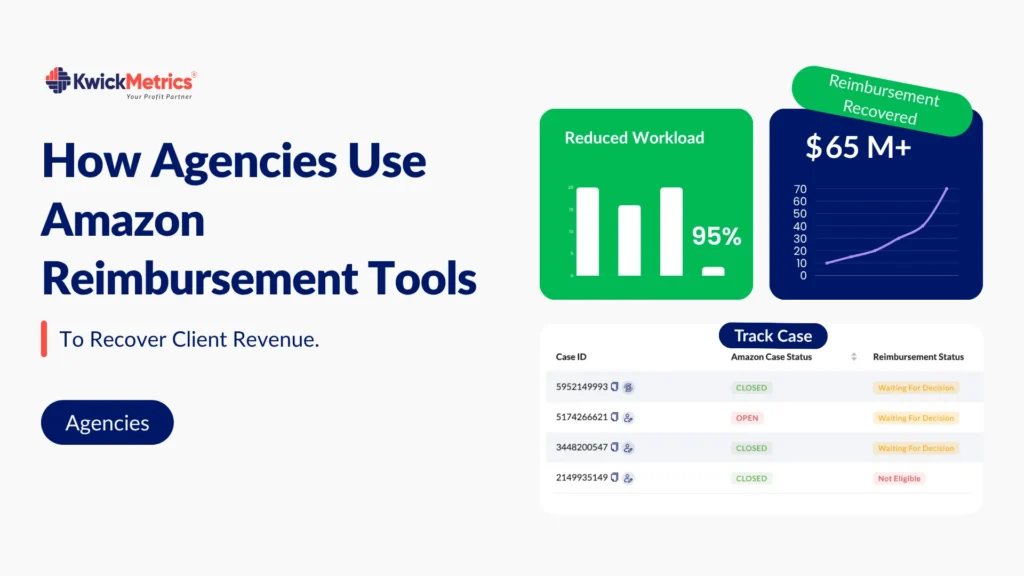
Table of Contents
- Introduction
- Key Takeaways
- Why Amazon FBA Reimbursements Are a Bigger Problem for Agencies
- What to Look for in an Amazon Reimbursement Tool Built for Agency Workflows
- How Agencies Use KwickMetrics to Track and Recover Client Reimbursements
- Making Reimbursement Recovery Visible to Clients
- Recover Lost FBA Revenue Across Every Client Account
- Get Your Questions Answered (FAQ)
Introduction
When a single client misses a reimbursement, it’s a minor issue. When you’re managing 20, 50, or 100 Amazon seller accounts with no consistent audit process, it becomes a portfolio-wide revenue problem — and quietly, a client trust problem.
Amazon FBA reimbursement for agencies isn’t about chasing small amounts per account. Across a client base, unclaimed reimbursements erase thousands in recoverable revenue every quarter. And since Amazon doesn’t proactively notify sellers when it owes them money, Unclaimed reimbursements erase thousands in recoverable revenue every quarter — and no amazon reimbursement service will catch them unless your agency has a structured process in place.
Key Takeaways
- Amazon owes your clients money right now — FBA lost inventory claims — the most overlooked category in fba reimbursement services — average 1–3% of annual revenue.
- The 2025 amazon reimbursement policy shift to cost-based payouts made proactive tracking non-negotiable for every agency.
- The right amazon reimbursement tool lets your team switch between client accounts, auto-detect eligible claims, and surface recovered revenue in client-facing reports.
Why Amazon FBA Reimbursements Are a Bigger Problem for Agencies
1. What Amazon owes your clients and rarely flags automatically
Amazon’s fulfillment network processes millions of orders daily. Errors are inevitable — and they don’t come with alerts. The most common FBA lost inventory claims and related issues include:
Knowing how to recover amazon fba reimbursements starts with knowing what to look for — most agencies are missing several claim types entirely.
- Lost inventory — units missing during inbound shipments or warehouse transfers
- Damaged & destroyed inventory — products harmed while in Amazon’s care
- Customer returns issues— incorrect refund, carrier damage, return and replacement lost
- Overcharged FBA fees — incorrect dimension or weight data inflating fees on every unit sold
- Shipment errors – Missing and excess shipment errors
Most FBA sellers lose 1–3% of annual revenue to these errors. On a $500K account, that’s up to $15,000 sitting unclaimed.
2. The 2025 Amazon reimbursement policy change agencies need to know
The amazon reimbursement policy shifted significantly in March 2025. Under this amazon reimbursement policy, inventory lost or damaged before a customer order is reimbursed at manufacturing cost — not selling price.
A product that cost $15 to source gets reimbursed at $15, not the $50 it retails for. Sellers must manually submit their sourcing costs in Amazon’s Inventory Defect and Reimbursement Portal; if they don’t, Amazon uses its own estimate, which is often lower. Many agency clients still haven’t done this. Auditing and updating cost data across your portfolio is one of the fastest ways to recover more for clients under the current policy.
3. The real cost of manual tracking across client accounts
Running an amazon audit reimbursement check manually across 15 clients is a different problem entirely. Running it across 15 is a different problem. Each client has a separate Seller Central login, separate reports, separate claim deadlines, and separate case histories.
Without a structured system for multi-client reimbursement tracking, most agencies either audit inconsistently or skip it entirely. Claims expire. Revenue disappears. And when a client eventually spots a discrepancy themselves, the agency is left explaining why it wasn’t caught — not a position any account team wants to be in.
What to Look for in an Amazon Reimbursement Tool Built for Agency Workflows
Most amazon reimbursement software — and most fba reimbursement software specifically — is built for single-seller use. Agencies need multi-account architecture.
The best amazon reimbursement software for agencies centralises all client accounts, auto-detects claims, and surfaces recoveries in client-facing reports.
1. Account switching without friction
All client accounts should live in one platform under organized folders — accessible with a single login. Switching between clients should take seconds, not separate sign-ins.
2. Automatic claim detection across all reimbursement types
The tool should scan each client account for every eligible category — lost inventory, damaged goods, fee errors, unreturned returns — without your team pulling reports manually.
An amazon fba reimbursement tool should scan all claim types automatically — lost inventory, fee errors, return discrepancies — without any manual report pulling
3. Reimbursement impact inside each client's P&L
When you switch into a client account, recovered amounts should reflect in that client’s profit view. This connects operational wins to financial outcomes, which matters when reporting back to clients.
4. Reimbursement service
Some tools flag opportunities and leave the filing to you. The best amazon reimbursement service for agencies is one where an expert team handles every claim — zero effort from your side, zero financial risk.
5. Real-time claim status tracking
Your team should see exactly where every open case stands — without logging into multiple Seller Central accounts one by one.
How Agencies Use KwickMetrics to Track and Recover Client Reimbursements
KwickMetrics functions as an amazon fba reimbursement service within a broader agency operations platform. It automatically detects lost and damaged inventory, overcharged FBA fees, fulfillment errors, and policy violations across your client accounts.

Your team logs in once, switches to a client account, and sees flagged reimbursement opportunities directly in the dashboard — no manual report-pulling required. Recovered amounts feed into that client’s per-client P&L reporting, making the financial impact visible immediately.
The better option for agencies is a service where an expert team handles every claim on your behalf — no effort required from your end, no credit card, and no monthly tool fees. With KwickMetrics’ managed reimbursement service, you only pay once Amazon processes the reimbursement. ‘For agencies, amazon revenue recovery at scale means detecting eligible cases before deadlines close — across every client, every month.
For claims requiring submission, Amazon reimbursement management tracks case status in real time, and the KwickMetrics team assists with filing and evidence submission on complex cases. The KwickMetrics for agencies dashboard keeps all client folders organized so your team can move efficiently across accounts without tool overload.

Making Reimbursement Recovery Visible to Clients
Recovering lost FBA revenue is valuable. Showing clients, you recovered it is what builds retention.
Amazon client reporting for agencies becomes significantly more powerful when reimbursement wins are tied directly to P&L numbers rather than buried in support case logs.

Recover Lost FBA Revenue Across Every Client Account
Your clients are owed money right now. The only question is whether your team has a system to find it before the claim windows close.
KwickMetrics helps agencies switch between client accounts, detect reimbursement opportunities automatically, and surface recovered revenue with our experts in client-facing reports — without adding hours to your team’s week.
Start your 14-day free trial or book a demo to see how it works across your client portfolio.
Get Your Questions Answered (FAQ)
Agencies can claim for lost or damaged inventory in Amazon's fulfillment centers, customer returns refunded but never received back, overcharged FBA fees from incorrect weight or dimension measurements, and inbound shipment discrepancies where Amazon received fewer units than shipped. Each category has its own claim process and filing deadline that agencies need to track across every client account.
For more details check this blog: https://www.kwickmetrics.com/blog/amazon-fba-reimbursement-guide
Since March 2025, Amazon calculates reimbursements based on estimated manufacturing cost rather than retail selling price — significantly reducing payout amounts across most categories. Claim windows have also tightened. Agencies should brief clients on lower expected recovery amounts and prioritize proactive auditing rather than waiting for clients to flag discrepancies after the fact. Start your Audit now
Yes. Tools like KwickMetrics allow agencies to switch between client accounts within a single platform, with all accounts organized in client accounts under one login. Reimbursement opportunities are detected automatically per account, raise claims and tracked through a real-time dashboard — without logging into separate Seller Central accounts for each client. No Credit card required, No tool fees, No Upfront fees, pay only if you get the reimbursement amount, Try KwickMetrics
Deadlines vary by claim type. Missing these windows means permanently forfeiting the reimbursement. Regular monthly audits across all client accounts are the only reliable way to ensure claims are filed before deadlines expire. Start your Audit now
Connect reimbursements to each client's P&L so recovered amounts appear as a financial line item, not just a case ticket. Surfacing these wins in co-branded dashboards alongside sales and ad performance gives clients a complete view of account health — and positions your agency as proactive rather than reactive, which directly supports retention conversations.
Manually, your team would need to log into each client's Seller Central, pull the relevant reports (inventory, returns, shipments), identify discrepancies, and submit cases individually — a process that takes hours per account and repeats every month. With KwickMetrics, you connect the client account once; the platform detects every eligible claim automatically and the expert team handles all case filing, follow-up, and closure on your behalf — no effort required from your team or the client.
In Seller Central, you'd need to log into each account separately, navigate to the Payments or Case Log report, and manually track open cases — there's no cross-account view. KwickMetrics solves this with a multi-account dashboard where your agency sees every client's flagged opportunities, active cases, and recovered amounts in one place, without switching logins.
